
What the syllabus asks you to cover
Ohm’s law, electric voltage, current, power, and energy. Conducting and insulating materials. Series and parallel electric circuits. Star-delta and delta-star conversion. Kirchhoff’s law. Linear and non-linear circuits. Bilateral and unilateral circuits. Active and passive circuits.
1. Voltage, current and Ohm's law
Voltage is the difference in electric potential between two points: energy transferred per unit charge. Its unit is the volt, equivalent to a joule per coulomb. Current is the rate of charge flow, , measured in amperes. Conventional current follows the direction of positive-charge flow; electrons in a metal drift in the opposite direction.
For an ohmic resistor under constant physical conditions, especially temperature, voltage and current are proportional:
Here V is voltage in volts, I is current in amperes and R is resistance in ohms. Ohm's law is a constitutive relationship for an ohmic element; it is not a universal linear law for every device.
2. Power and energy
Instantaneous electrical power is . With the passive sign convention, positive power means the element absorbs energy. For a resistor, . Energy is the time integral of power; for constant power, .
Keep units consistent: watts multiplied by seconds give joules; kilowatts multiplied by hours give kilowatt-hours. One kilowatt-hour equals 3.6 million joules. A device's power rating and its energy consumption are different quantities.
3. Conductors, insulators and semiconductors
Conductors such as copper have mobile charge carriers and relatively low resistivity. Insulators strongly restrict conduction under ordinary conditions; insulation can still leak or break down at sufficiently high electric field. Semiconductor conductivity depends on material, temperature, illumination and doping. These classifications describe behaviour under stated conditions, not an absolute ability or inability to carry current.
4. Series and parallel circuits
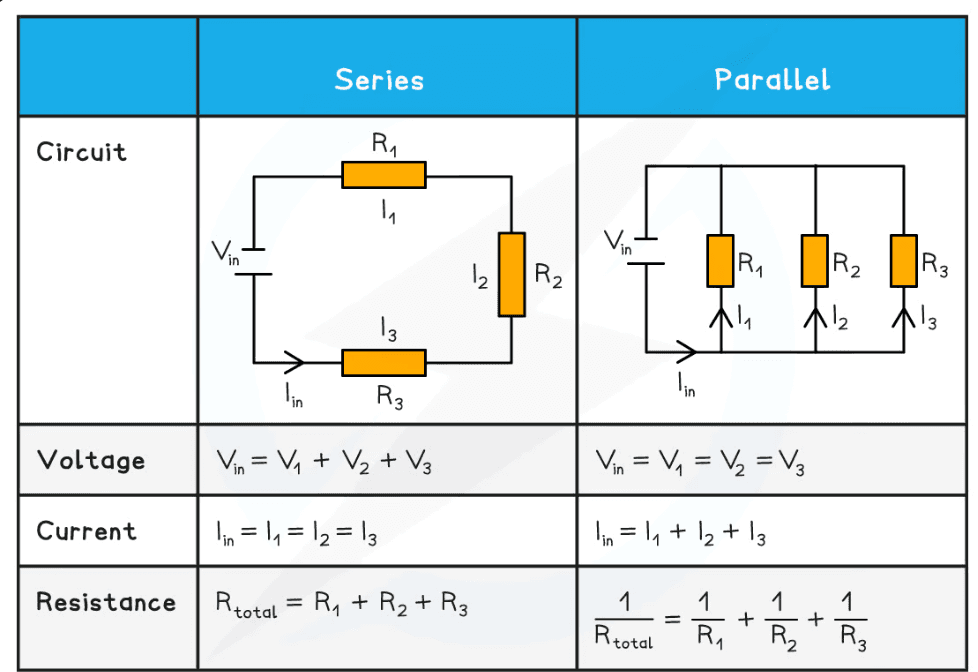
Series elements share a current when no branch exists between them. Their voltage drops add. For resistors:
Parallel branches share the same pair of nodes and therefore the same voltage. Their currents add:
An open component in a series path interrupts that path. An open parallel branch does not necessarily stop current through the other branches. Identify nodes before deciding that elements are in series or parallel.
5. Star–delta conversion
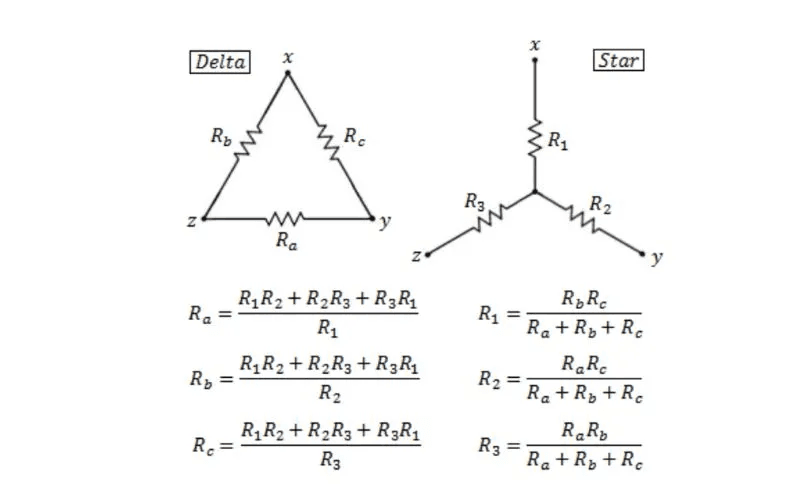
A star network joins three resistors to a common internal node. A delta network joins the three external terminals in a loop. An equivalent conversion preserves the resistance seen between external terminals, not each individual resistor value.
For delta resistors , define . Then the star resistor at terminal a is ; obtain the other two by rotating the labels. For star-to-delta, . Draw and label the terminals before substituting.
6. Kirchhoff's laws
Kirchhoff's current law expresses charge conservation at a node: the algebraic sum of currents is zero. Choose a sign convention and use it consistently.
Kirchhoff's voltage law for a lumped-circuit loop states that the algebraic sum of voltage rises and drops is zero. In circuit models involving time-varying linked magnetic flux, induced electromotive force must be included consistently.
7. Linear and nonlinear behaviour
A linear circuit satisfies superposition: scaling an input scales its response, and adding inputs adds their responses. Constant-parameter ideal resistors, inductors and capacitors are linear elements under their usual models. Diodes and transistors generally have nonlinear characteristics, although a small-signal model may approximate their behaviour near an operating point.
8. Bilateral and unilateral behaviour
Bilaterality concerns behaviour when the direction or port orientation is reversed. A resistor is a familiar bilateral element; a rectifying diode exhibits directional behaviour. Do not infer linearity solely from bilaterality: direction symmetry and superposition describe different properties.
9. Active and passive elements
A passive element cannot deliver net energy without previously receiving or storing it. Resistors dissipate energy; capacitors and inductors store and return energy. Sources supply energy, and transistor or op-amp amplifier circuits draw output energy from a power supply. Component classifications sometimes use different conventions; a diode's control of conduction does not imply power gain.
10. Worked example
A 12 V source supplies a 6 ohm resistor. The current is . The absorbed power is . Over five minutes, energy is , or 0.002 kWh.
If a second 6 ohm resistor is added in parallel across the same ideal source, equivalent resistance becomes 3 ohms. Total current becomes 4 A; the voltage across each branch remains 12 V. Each branch still draws 2 A.
11. Common mistakes
- Applying as a linear law to any arbitrary semiconductor device.
- Mixing watts with kilowatts, or minutes with seconds, in an energy calculation.
- Calling elements parallel because they look parallel on a drawing rather than checking both nodes.
- Assuming a bilateral element must be linear, or that an amplifier creates energy.
12. Check your understanding
Without reading back, explain why adding a parallel resistor increases the total current from an ideal voltage source. Then calculate the current, power and one-minute energy use for a 9 V source across a 3 ohm resistor. Check the result using both and .
Pause and recall
Without looking back, explain the main idea, recall a key definition or formula, and describe when it applies. Include assumptions and units where relevant. Revisit any step you could not explain.